In our increasingly connected world, where every device from smartphones to smart TVs demands power, finding enough outlets can feel like an unending quest. Have you ever found yourself in a tangled mess of cables, desperately searching for a free socket, or worse, worrying about the safety of your valuable electronics? This guide cuts through the confusion, offering a comprehensive look at power strips, helping you understand their critical role, distinguish between types, and ultimately choose the perfect power solution for your home or office.
What is a Power Strip and Why You Need One?
A power strip, also known by various names such as a power board or multi-socket, is a simple yet essential device that expands a single wall electrical outlet into multiple usable sockets. It typically features an elongated casing with several outlets, connected by a flexible cable and plug to the main power supply. Beyond just adding more places to plug in, power strips serve as a central hub for managing your electronic devices.
The primary function of a power strip is convenience, allowing you to power numerous gadgets—from computers and monitors to lamps, phone chargers, and gaming consoles—simultaneously from one source. This eliminates the need for multiple wall adapters and helps to organize your workspace, reducing cable clutter. In today’s tech-driven environments, where every home and office is filled with electronics, power strips are indispensable tools for efficient power distribution.
Common Types of Power Strips on the Market
Not all power strips are created equal. They vary significantly in design, features, and the level of protection they offer. Understanding the different types is crucial for making an informed decision that meets your specific needs and safeguards your devices.
Basic Power Strip
A basic power strip is the simplest form, offering multiple outlets and often a single on/off switch without additional features or protection systems. These are essentially glorified extension cords.
- Pros: Affordable, provides multiple outlets, good for low-power devices.
- Cons: Offers no protection against power surges or voltage spikes, can be easily overloaded.
- Ideal for: Non-sensitive electronics like desk lamps, floor lights, or chargers for small personal devices where consistent voltage isn’t critical.
|
Our Picks for the Best Power strip in 2026
As an Amazon Associate I earn from qualifying purchases.
|
||
| Num | Product | Action |
|---|---|---|
| 1 | Surge Protector Power Strip - Nuetsa Flat Plug Extension Cord with 8 Outlets and 4 USB Ports, 6 Feet Power Cord (1625W/13A), 2700 Joules, ETL Listed, Black |

|
| 2 | Belkin 12-Outlet Surge Protector Power Strip w/ 12 AC Outlets & 8ft Flat Plug, UL-Listed Heavy-Duty Extension Cord for Home, Office, Travel, Computer, Laptop, Charger - 3,940 Joules of Protection |
|
| 3 | Anker Power Strip with 2100J Surge Protector, Outlet Extender, 5ft Extension Cord with Multiple Outlets, 12 AC, 2 USB A,1 USB C Port for 20W, Home Office, Dorm Room Essentials, TUV Listed |
|
| 4 | Power Strip, ALESTOR Surge Protector with 12 Outlets and 4 USB Ports, 6 Feet Extension Cord (1875W/15A), 2700 Joules, ETL Listed, Black |
|
| 5 | 6 Ft Surge Protector Power Strip - 8 Widely Outlets with 4 USB Ports, 3 Side Outlet Extender with 6 Feet Extension Cord, Flat Plug, Wall Mount, Desk USB Charging Station, ETL,White |
|
| 6 | Surge Protector Power Strip - HANYCONY 8 Outlets 4 USB (2 USB C) Charging Ports, Multi Plug Outlet Extender, 5Ft Braided Extension Cord, Flat Plug Wall Mount Desk Charging Station for Home Office ETL |
|
| 7 | Power Strip Surge Protector, Olcorife Ultra Thin Flat Plug Extension Cord 5ft, 6 Outlets 3 USB Ports(1 USB C), 3 Sided Outlet Extender for Home Office Travel Dorm Room Essentials, White |
|
| 8 | 6Ft Power Strip Surge Protector - Yintar Extension Cord with 6 AC Outlets and 3 USB Ports for for Home, Office, Dorm Essentials, 1680 Joules, ETL Listed, (Black) |
|
| 9 | KMC 6-Outlet Surge Protector Power Strip 2-Pack, 900 Joules, 4-Foot Extension Cord, Overload Protection, Black |
|
| 10 | Wall Charger, Surge Protector, QINLIANF 5 Outlet Extender with 4 USB Charging Ports, 3-Sided 1680J Power Strip Multi Plug Adapter Spaced for Home Travel Office |
|
Surge Protector Power Strip
A surge protector power strip looks similar to a basic power strip but includes internal components, primarily Metal Oxide Varistors (MOVs), designed to protect devices from voltage spikes. When a power spike occurs, MOVs redirect excess energy into the grounding wire, preventing it from reaching connected electronics.
- Pros: Essential for protecting sensitive and expensive electronics from sudden voltage surges, often includes a circuit breaker for overload protection.
- Cons: MOVs degrade over time and with each surge absorbed, requiring replacement every few years.
- Ideal for: Computers, televisions, gaming consoles, routers, modems, smart home systems, and any device containing sensitive circuits or storing important data.
Smart Power Strip
Smart power strips integrate advanced technology, allowing for remote control, scheduling, and energy monitoring of individual outlets via smartphone apps or voice commands. Some can even automate power delivery based on your presence or device activity.
- Pros: Enhanced energy efficiency by eliminating “phantom load,” convenience of remote control, automation capabilities, often includes surge protection and USB ports.
- Cons: Generally more expensive, setup can sometimes be complex, reliance on Wi-Fi connectivity.
- Ideal for: Tech-savvy households, smart homes, and offices looking to automate device power, monitor energy consumption, and reduce standby power waste.
USB Power Strip
These power strips go beyond traditional AC outlets by incorporating built-in USB charging ports (USB-A and often USB-C). This feature eliminates the need for bulky wall adapters for charging smartphones, tablets, and other USB-powered devices.
- Pros: Frees up AC outlets, provides convenient direct charging for multiple mobile devices, often includes surge protection.
- Cons: USB ports may not offer the fastest charging speeds on all models, limited number of ports compared to dedicated chargers.
- Ideal for: Desks, bedside tables, or any area where multiple USB-powered devices are frequently charged alongside traditional electronics.
Travel Power Strip
Designed for portability and convenience on the go, travel power strips are compact and lightweight. They often feature a flat plug and multiple outlets, sometimes with universal compatibility and built-in USB ports.
- Pros: Compact size, easy to pack, provides extra outlets in hotels or limited spaces, some models offer universal adapters.
- Cons: Typically have fewer outlets and lower surge protection ratings, shorter cords.
- Ideal for: Travelers, remote workers, or anyone needing to power multiple devices while away from home.
Comparing Popular Power Strip Types
To help you visualize the differences, here’s a detailed comparison of the most common power strip types:
| Feature | Basic Power Strip | Surge Protector Power Strip | Smart Power Strip | USB Power Strip | Travel Power Strip |
|---|---|---|---|---|---|
| Main Function | Outlet expansion | Outlet expansion & surge defense | Smart control, energy management & surge | Outlet expansion & USB charging | Portable outlet expansion |
| Surge Protection | No | Yes (Joule rating) | Often yes (Joule rating) | Often yes (Joule rating) | Usually minimal or none |
| USB Ports | Rarely | Sometimes | Often | Yes | Often |
| Smart Features | No | No | Yes (App/voice control, scheduling) | No | No |
| Price | Low | Moderate | High | Moderate | Low to Moderate |
| Durability | Basic plastic | Varies (plastic, metal) | Varies (plastic) | Varies (plastic) | Varies (compact plastic) |
| Key Benefit | Cost-effective extra outlets | Protects sensitive electronics | Remote control & energy savings | Convenient mobile device charging | Portability and convenience |
| Best For | Lamps, low-power chargers | Computers, TVs, gaming consoles | Smart homes, offices, tech enthusiasts | Desktops, bedside charging | Travel, mobile workspaces |
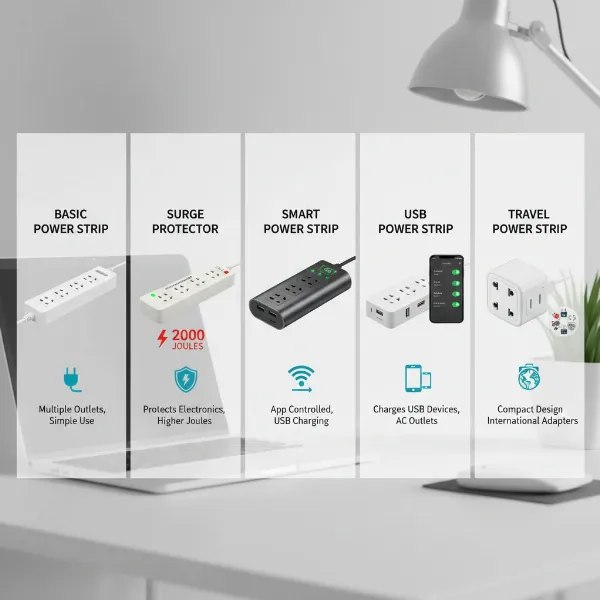 An illustrative infographic showing different types of power strips, including basic, surge protector, smart, and USB models, highlighting their key features and typical appearances in a modern home or office setting.
How to Choose the Right Power Strip (Buying Guide)
Selecting the ideal power strip requires careful consideration of your specific needs, technical requirements, and safety features. Don’t just grab the cheapest option; an informed decision can protect your valuable electronics and ensure long-term safety.
Determine Your Usage Needs
Before anything else, assess what you’ll be plugging in and where.
- Number of Outlets: Count the devices you need to connect simultaneously. Factor in future purchases. Power strips are available with up to 24 outlets, but most home users find 6-12 sufficient.
- Type of Devices: Are you powering sensitive electronics like computers and TVs, or just basic lamps? High-power appliances like space heaters or microwaves should never be plugged into a power strip, only directly into a wall outlet.
- Location: Consider where the power strip will be used. A desktop requires easily accessible outlets, while a mounted strip might be better for reducing clutter under a desk.
Technical Factors to Consider
The technical specifications are paramount for safety and effectiveness, especially for surge protectors.
- Maximum Power Capacity (Amperage/Wattage): This indicates how much power the strip can safely handle. Ensure it meets or exceeds the combined wattage of all devices you plan to connect. Some strips offer 20-amp capacity for higher voltage applications, including a circuit breaker.
- Surge Protection (Joule Rating, Clamping Voltage, Response Time):
- Joule Rating: This measures how much energy the protector can absorb before it fails. Higher joule ratings mean better protection and longer lifespan. For sensitive electronics, aim for at least 1,500 to 2,000 joules; 2,500 joules or higher is recommended for high-end gaming PCs or home theater systems.
- Clamping Voltage: This is the voltage level at which the surge protection kicks in. A lower clamping voltage (around 330V) indicates better protection.
- Response Time: Measures how quickly the unit reacts to a surge. Faster response times (measured in nanoseconds) offer superior protection.
- Circuit Breaker: A built-in circuit breaker is essential as it automatically cuts power to prevent overloading and potential fires. This is a crucial safety feature for any power strip.
- Safety Standards (UL/cUL/cETL Certification): Always look for certification marks like UL (Underwriters Laboratories) in the US or cUL/cETL in Canada. These verify that the product has been tested and meets strict national safety standards, ensuring quality and reliability.
- Cord Length and Type: Select a cord long enough to reach your grounded AC outlet without stretching. Cord lengths can range up to 24 feet. Some strips also offer flat plugs for easier placement behind furniture.
- Outlet Spacing and Configuration: Wide-spaced outlets are vital to accommodate bulky power adapters (“wall warts”) without blocking adjacent sockets. Some designs include right-angle, front-facing, or end-mounted outlets for specific applications.
- USB Ports: If you have many USB-powered devices, choose a strip with dedicated USB-A and/or USB-C ports (especially fast-charging Power Delivery ports) to free up AC outlets.
- Build Quality: Look for durable construction. Fire-retardant plastic is common, while some industrial models feature metal casings for better heat dissipation.
- Indicator Lights: For surge protectors, indicator lights (e.g., “Protected” or “Grounded”) show if the protection is active and if the wiring is grounded. These lights are important for monitoring the strip’s integrity, as surge protection degrades over time.
Brand and Price Considerations
While specific brand recommendations can change, some brands consistently offer reliable power strips and surge protectors.
- Reputable Brands: Brands like Anker, Belkin, TP-Link (Kasa), Eaton, CyberPower, and Tripp Lite are well-known for producing quality power management solutions.
- Price vs. Protection: Basic power strips are inexpensive, but their lack of protection can be a costly misconception if sensitive electronics are damaged. Surge protectors, while slightly more expensive, offer vital defense. Smart power strips are at the higher end due to their advanced features. View your purchase as an investment in protecting your devices.
User Reviews and Expert Opinions
Always check user reviews and expert assessments. Online reviews can provide insights into a product’s real-world performance, durability, and any potential issues. Referencing articles from reputable tech review sites can help validate product claims.
Top 5 Power Strips for Every Need
Based on comprehensive research and expert insights, here are five highly-rated power strips that excel in quality, features, and value, catering to various user requirements:
-
Anker Surge Protector Power Strip: (Best Overall)
- Pros: Excellent variety of safety features including surge protection (2,100 joules), fire resistance, overload protection, and temperature control. Features 12 AC outlets, 2 USB-A ports, and 1 fast-charging USB-C port, with ample space between outlets.
- Cons: Thick extension cord can be less flexible.
- Reason to choose: A robust and versatile option for comprehensive device protection and charging, ideal for busy workstations or entertainment centers.
-
Belkin 12-Outlet Pivot-Plug Surge Protector: (Best for Max Surge Protection & Bulky Adapters)
- Pros: Offers exceptional surge protection (often 3,940-4,320 joules). Features 12 widely spaced, rotating outlets that accommodate bulky adapters without blocking adjacent sockets. Includes a clip-on cable organizer and sliding safety covers.
- Cons: Typically lacks USB ports.
- Reason to choose: Perfect for protecting high-value electronics and managing numerous devices with various adapter sizes, particularly in home offices or media setups.
-
TP-Link Kasa Smart Wi-Fi Power Strip HS300: (Best Smart Power Strip)
- Pros: Features six smart AC outlets that can be individually controlled, along with three USB ports. Offers energy monitoring, remote control, scheduling, and voice control via Alexa, Google Assistant, and HomeKit compatibility. Built-in surge protection.
- Cons: Higher price point.
- Reason to choose: An excellent choice for smart homes, allowing precise control and energy management over multiple connected devices, while also providing surge protection.
-
Tessan Flat Plug Extension Cord Power Strip: (Best for Remote Work/Travel)
- Pros: Compact and portable design with a flat plug, making it easy to pack for travel or use behind furniture. Features four widely spaced AC outlets and three standard USB ports. Can be wall-mounted.
- Cons: Shorter extension cord, moderate surge protection (around 900 joules).
- Reason to choose: A practical, space-saving solution for increasing outlet access and charging devices efficiently in limited spaces, perfect for travelers or temporary setups.
-
Amazon Basics 6-Outlet Surge Protector: (Best Value)
- Pros: Affordable and reliable, providing up to 1,000 joules of surge protection. Features six AC outlets and dual USB-A ports. Includes a power switch and an LED indicator for surge protection status.
- Cons: Limited space between outlets for larger adapters.
- Reason to choose: A solid, no-frills option for basic surge protection and additional outlets without breaking the bank, suitable for general home use with less sensitive devices.
How to Use and Maintain Your Power Strip Safely
Proper use and maintenance are crucial for maximizing the lifespan of your power strip and, more importantly, ensuring the safety of your home and devices. Electrical hazards like fires and damage to electronics are often preventable with a few simple guidelines.
Safe Usage Practices
- Avoid Overloading: Never plug in more devices than the power strip’s maximum power capacity (wattage or amperage) allows. Overloading can lead to overheating, tripped circuit breakers, or even fires. High-power appliances should always be plugged directly into a wall outlet.
- Plug Directly into Wall Outlets: Always plug your power strip directly into a grounded wall outlet. Avoid “daisy-chaining,” which is connecting multiple power strips or surge protectors together. This practice significantly increases the risk of overloading and fire hazards and can void surge protection warranties.
- Proper Placement: Ensure the power strip is in a well-ventilated area, away from flammable materials. Never hide cords under rugs or furniture, as this can trap heat and damage the insulation, increasing fire risk.
- Use Indoor-Rated Strips Indoors Only: Do not use indoor-rated power strips or surge protectors outdoors or in damp environments like bathrooms or garages. Moisture and electricity are a dangerous combination.
- Grounding: Ensure your wall outlet is properly grounded. Three-prong plugs on power strips are designed for grounded outlets, providing an essential safety feature against electric shock.
Maintenance Tips for Longevity
- Monitor Indicator Lights: For surge protectors, regularly check the “Protected” or “Protection On” indicator light. If this light goes out, it means the internal surge protection components (MOVs) have degraded and can no longer protect your devices, even if the outlets still function. Replace the strip immediately.
- Replace After Major Electrical Events: After a severe lightning strike, a significant power outage, or a serious brownout, it’s wise to replace your surge protectors. Even if the indicator light is still on, a major electrical event can exhaust most of its remaining protection capacity.
- Annual Inspection: Once a year, inspect all your power strips for signs of wear and tear. Look for frayed cords, scorch marks, cracks in the housing, discolored plugs, or loose outlets. Any visible damage is a clear sign that the unit should be retired and replaced.
- Unplug When Not in Use: If a power strip is not being used, or if you’re leaving for an extended period, unplug it from the wall. This prevents “phantom load” power consumption and offers an extra layer of safety during storms.
“Many people mistakenly believe a basic power strip offers surge protection, a costly misconception that can leave thousands of dollars’ worth of electronics at risk. Always look for a joule rating to confirm true surge protection.” – EcoFlow Expert, Electrical Safety Specialist
Conclusion
Choosing the right power strip is more than just adding outlets; it’s a vital decision that impacts the safety and longevity of your valuable electronics. By understanding the crucial distinction between a basic power strip and a surge protector, assessing your power needs, and prioritizing key technical specifications like joule rating and safety certifications, you empower yourself to make smart, informed choices. Regular maintenance and adherence to safety guidelines are equally important in safeguarding your home and devices against unexpected electrical events.
Ready to upgrade your power management? Which features matter most to you when selecting your next power strip?
Frequently Asked Questions
What’s the main difference between a power strip and a surge protector?
A power strip primarily expands the number of available outlets from a single wall socket, offering convenience without electrical protection. A surge protector, however, includes internal components (Metal Oxide Varistors or MOVs) that detect and divert excess voltage during power surges, shielding connected devices from damage. The clearest way to tell them apart is by checking for a joule rating on the packaging or the device itself; if it lacks one, it’s typically just a basic power strip.
How many joules should a surge protector have for home use?
For everyday home electronics like TVs, routers, and computers, a minimum of 1,500 to 2,000 joules is recommended for solid protection. For high-end devices such as gaming PCs, professional workstations, or home theater systems, opt for 2,500 joules or higher. A higher joule rating indicates that the surge protector can absorb more energy over its lifetime, providing stronger and longer-lasting defense for your equipment.
Is a UPS better than a surge protector for computers?
Yes, an Uninterruptible Power Supply (UPS) is generally better for computers than a standard surge protector because it offers both surge protection and temporary battery backup power. This backup allows your computer to stay on long enough during a power outage for you to save your work and shut down safely, preventing data loss or hardware damage. A standard surge protector only guards against sudden voltage spikes but provides no power during a complete blackout.
How often should power strips and surge protectors be replaced?
Power strips and surge protectors have a limited lifespan and degrade over time. While a basic power strip might last longer, surge protectors should ideally be replaced every 3-5 years, or immediately after a major electrical event like a lightning strike, even if their indicator lights are still on. This is because the internal MOVs that provide protection wear out with each surge they absorb, reducing their effectiveness.