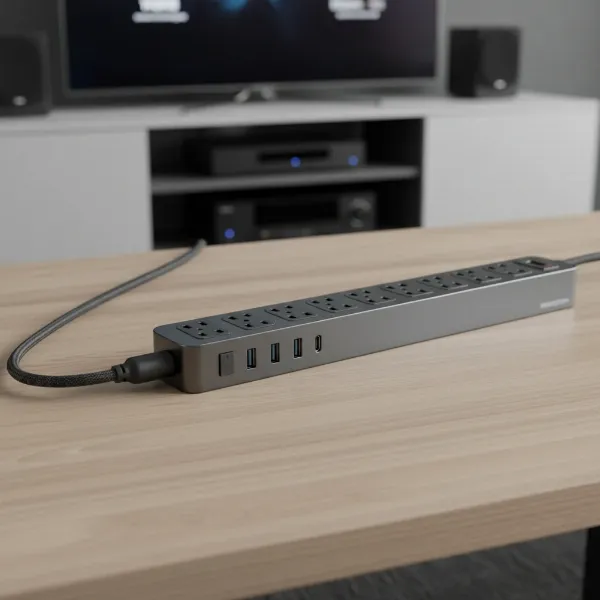
Have you ever arrived at a hotel, only to find a single, awkwardly placed outlet struggling to power your phone, laptop, and tablet? This common travel dilemma highlights why a reliable power strip is an essential companion for any globetrotter. In today’s hyper-connected world, we travel with an ever-increasing array of electronic devices, all demanding power. A well-chosen power strip can transform a single wall socket into a versatile charging hub, ensuring all your gadgets stay powered up and ready for your adventures, whether you’re navigating bustling airports, cozy hotel rooms, or even cruise ship cabins. This guide will help you navigate the world of power strips to select the ideal one for your specific travel requirements and budget.
What is a Power Strip and Why Do You Need One for Travel?
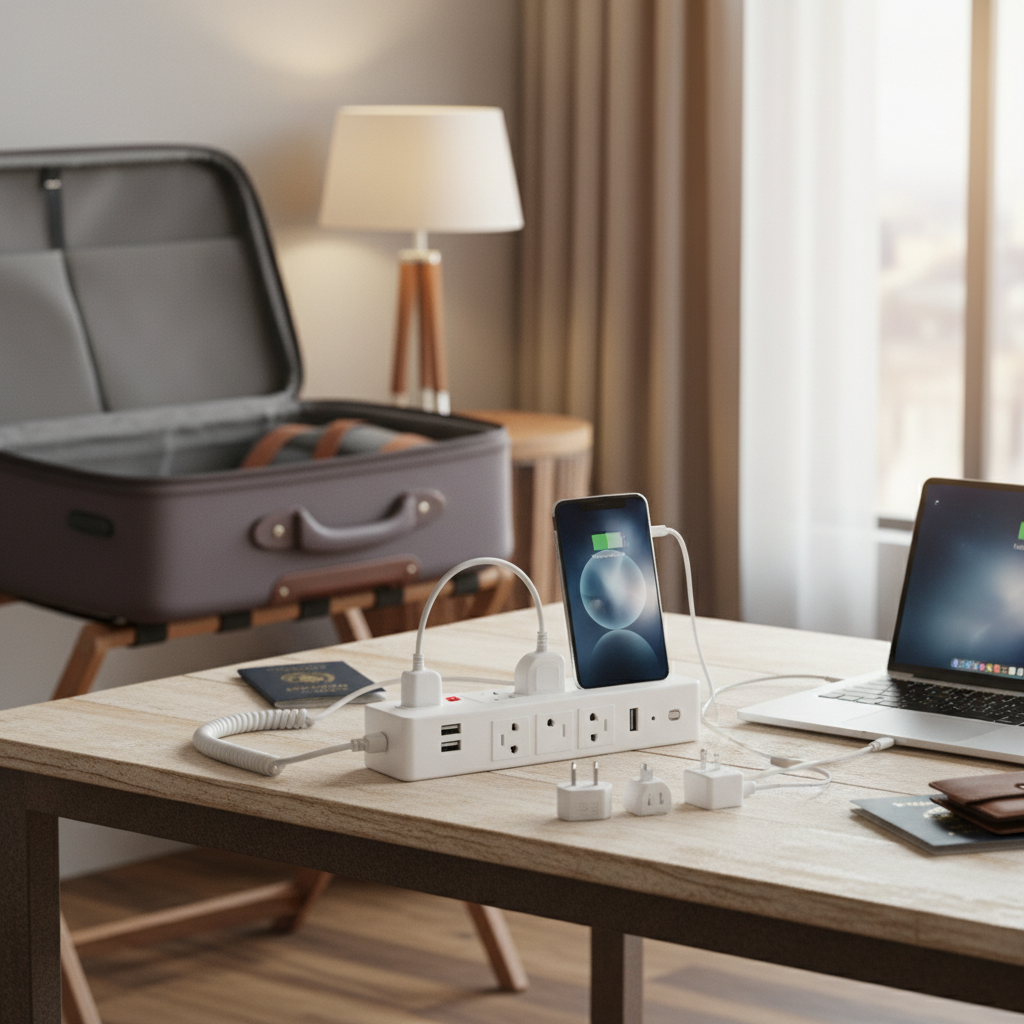
A power strip, also known as an extension block, outlet strip, or multi-plug adapter, is a device that allows multiple electrical devices to be plugged into a single wall outlet. At its core, a power strip provides expanded access to electrical sockets, an invaluable benefit when travelling to destinations with limited or inconveniently located outlets, such as hotels, airports, or coffee shops. Instead of searching frantically for spare sockets, a compact travel power strip centralizes your charging needs.
The primary function of a power strip is to convert one electrical outlet into several, offering convenience and efficiency. Modern travel power strips often go beyond just AC outlets, integrating USB-A and USB-C ports to directly charge smartphones, tablets, smartwatches, and laptops, reducing the need for bulky individual chargers. This multi-functionality is crucial for devices commonly carried during travel, including smartphones, laptops, cameras, portable speakers, and even medical equipment like CPAP machines. The ability to charge multiple devices simultaneously from one wall socket significantly enhances productivity and reduces clutter in your luggage and on your nightstand.
Popular Types of Power Strips for Travelers
The market offers a diverse range of power strips, each designed with specific features catering to different needs. For travelers, understanding these types is key to selecting the most suitable device.
Basic Travel Power Strip
A basic travel power strip typically offers multiple AC outlets in a compact, lightweight form factor. These are designed for simplicity and portability, focusing solely on providing additional power sockets.
- Description: These are straightforward devices, often cube-shaped or rectangular, with two to four AC outlets. They usually have a short, sometimes retractable, power cord for easy packing.
- Advantages: Extremely portable, lightweight, and often the most affordable option. They excel at expanding outlet access without unnecessary bulk.
- Disadvantages: Generally lack advanced features like surge protection or USB charging ports. They do not convert voltage, so all connected devices must be dual-voltage compatible.
- Suitable Applications: Ideal for domestic travel or international trips where you only need more AC outlets and your devices are all dual-voltage. Perfect for minimalist travelers.
|
Our Picks for the Best Power strip in 2026
As an Amazon Associate I earn from qualifying purchases.
|
||
| Num | Product | Action |
|---|---|---|
| 1 | 6 Ft Surge Protector Power Strip - 8 Widely Outlets with 4 USB Ports, 3 Side Outlet Extender with 6 Feet Extension Cord, Flat Plug, Wall Mount, Desk USB Charging Station, ETL,White |

|
| 2 | Anker Power Strip with 2100J Surge Protector, Outlet Extender, 5ft Extension Cord with Multiple Outlets, 12 AC, 2 USB A,1 USB C Port for 20W, Home Office, Dorm Room Essentials, TUV Listed |
|
| 3 | Belkin 12-Outlet Surge Protector Power Strip w/ 12 AC Outlets & 8ft Flat Plug, UL-Listed Heavy-Duty Extension Cord for Home, Office, Travel, Computer, Laptop, Charger - 3,940 Joules of Protection |
|
| 4 | Surge Protector Power Strip - HANYCONY 8 Outlets 4 USB (2 USB C) Charging Ports, Multi Plug Outlet Extender, 5Ft Braided Extension Cord, Flat Plug Wall Mount Desk Charging Station for Home Office ETL |
|
| 5 | Wall Charger, Surge Protector, QINLIANF 5 Outlet Extender with 4 USB Charging Ports, 3-Sided 1680J Power Strip Multi Plug Adapter Spaced for Home Travel Office |
|
| 6 | Power Strip, ALESTOR Surge Protector with 12 Outlets and 4 USB Ports, 6 Feet Extension Cord (1875W/15A), 2700 Joules, ETL Listed, Black |
|
| 7 | 6Ft Power Strip Surge Protector - Yintar Extension Cord with 6 AC Outlets and 3 USB Ports for for Home, Office, Dorm Essentials, 1680 Joules, ETL Listed, (Black) |
|
| 8 | Surge Protector Power Strip - Nuetsa Flat Plug Extension Cord with 8 Outlets and 4 USB Ports, 6 Feet Power Cord (1625W/13A), 2700 Joules, ETL Listed, Black |
|
| 9 | KMC 6-Outlet Surge Protector Power Strip 2-Pack, 900 Joules, 4-Foot Extension Cord, Overload Protection, Black |
|
| 10 | Power Strip Surge Protector, Olcorife Ultra Thin Flat Plug Extension Cord 5ft, 6 Outlets 3 USB Ports(1 USB C), 3 Sided Outlet Extender for Home Office Travel Dorm Room Essentials, White |
|
Surge Protector Power Strip
While not all power strips include surge protection, those that do are designed to safeguard your electronics from sudden voltage spikes. This is a critical feature for protecting valuable devices.
- Description: A surge protector power strip looks similar to a basic power strip but includes internal components (like Metal Oxide Varistors or MOVs) that divert excess voltage away from connected devices. They are rated in Joules, indicating their capacity to absorb surge energy.
- Advantages: Offers protection against power surges that can damage sensitive electronics like laptops, cameras, and smartphones, especially beneficial in areas with unstable power grids.
- Disadvantages: Can be slightly larger and heavier than basic power strips due to the internal surge protection circuitry. Some cruise lines prohibit surge protectors, so always check policies.
- Suitable Applications: Highly recommended for travelers carrying expensive or sensitive electronics, particularly when visiting destinations known for inconsistent power supply. However, note that many travel power strips designed to be “cruise approved” intentionally omit surge protection.
Smart Power Strip
Smart power strips incorporate connectivity features, allowing users to control outlets remotely via a smartphone app or voice commands. While less common for travel, some compact versions exist.
- Description: These strips typically include Wi-Fi connectivity, enabling individual outlet control, scheduling, and energy monitoring through an app. Some may integrate with smart home ecosystems.
- Advantages: Offers enhanced control and energy efficiency. You can turn off unused devices remotely, which can be useful for saving power in a hotel room.
- Disadvantages: Can be more expensive and might require a stable Wi-Fi connection to utilize all smart features, which isn’t always reliable during travel.
- Suitable Applications: Best for tech-savvy travelers who prioritize remote control and energy management, or for those using it as a hybrid home/travel device.
USB Power Strip
With the proliferation of USB-powered devices, power strips featuring integrated USB-A and USB-C charging ports have become incredibly popular, particularly for travel.
- Description: These power strips combine traditional AC outlets with multiple USB charging ports (USB-A and often USB-C, some with Power Delivery (PD) for faster charging).
- Advantages: Reduces the need to carry multiple USB wall adapters, saving space and weight. USB-C PD ports can charge modern laptops and smartphones much faster than standard USB-A ports.
- Disadvantages: The total power output for USB ports might be shared, leading to slower charging if many devices are connected simultaneously.
- Suitable Applications: Excellent for travelers with multiple USB-chargeable devices (phones, tablets, e-readers, power banks) who want to minimize their packing. Many modern travel power strips incorporate USB ports as a standard feature.
Travel Power Strip with International Plug Adapters
These are purpose-built for international travel, often featuring interchangeable plug adapters or universal sockets, and are voltage compatible worldwide.
- Description: These strips combine power outlets and USB ports with the flexibility of interchangeable plug types (e.g., Type A, C, G, I) or universal input sockets, allowing them to connect to various wall outlets globally. They are typically rated for 100-240V input.
- Advantages: Eliminates the need for separate plug adapters for each country, offering an all-in-one solution for international travelers.
- Disadvantages: Can be slightly bulkier or more expensive than basic travel strips. They generally do not convert voltage, meaning your devices still need to be dual-voltage. Some specialized voltage converters also include power strip features, but these are heavier.
- Suitable Applications: Indispensable for frequent international travelers who visit countries with different electrical outlet standards.
Comparison Table of Power Strip Types
| Feature / Type | Basic Power Strip | Surge Protector Power Strip | Smart Power Strip | USB Power Strip | Travel Power Strip with Adapters |
|---|---|---|---|---|---|
| Primary Function | Expand AC outlets | Protects against surges | Remote control, automation | Charge USB devices | Universal outlet compatibility |
| Typical Outlets | 2-4 AC | 3-6 AC (+/- USB) | 3-6 AC (+/- USB) | 2-4 AC + 2-4 USB | 2-3 AC + 1-3 USB, changeable plug |
| Surge Protection | No | Yes (Joules rating) | Optional | Optional | Often built-in, but check for cruises |
| Voltage Conversion | No | No | No | No | No (operates 100-240V) |
| Size & Portability | Very compact, lightweight | Moderate | Moderate (some compact) | Compact, lightweight | Moderate |
| Price Range | Low | Moderate | High | Moderate | Moderate to High |
| Special Features | Simplicity | Safety for electronics | App control, scheduling | Fast USB-C PD charging | Interchangeable plugs, worldwide use |
| Cruise Approved | Yes (if non-surge) | Usually No | Yes (if non-surge) | Yes (if non-surge) | Yes (if non-surge) |
Buying Guide: How to Choose the Right Power Strip
Selecting the perfect travel power strip requires careful consideration of your specific needs and technical specifications.
Determine Your Usage Needs
Before diving into technicalities, assess what you’ll be powering and where.
- Number of Outlets: Count the number of AC devices (laptops, camera chargers, hair tools) and USB devices (phones, tablets, smartwatches) you typically travel with. Look for a strip that offers enough of both. A common setup might be 2-3 AC outlets and 2-4 USB ports (including at least one USB-C PD).
- Type of Devices: Consider if you’re primarily charging low-power gadgets or high-wattage items. High-power devices like hair dryers or travel irons might require a strip with a higher maximum wattage rating.
- Travel Destination: Are you traveling domestically or internationally? International travel necessitates considering voltage compatibility and plug types. Many modern electronics are dual-voltage (100-240V), meaning they’ll work with different voltages but still require a physical plug adapter [3.3, 4.3].
- Location: Will you primarily use it in hotels, airports, or on a cruise? Cruise ships often have strict policies against surge protectors, making non-surge protected strips a must [4.4].
Key Technical Factors to Consider
Technical specifications play a crucial role in the safety and functionality of your travel power strip.
- Maximum Power/Current Rating: Check the power strip’s maximum wattage (W) and amperage (A) rating. Ensure it can handle the combined power draw of all devices you intend to plug in. Overloading a power strip is a significant fire hazard [3.3, 1.1]. For instance, a strip rated for 1250W at 10A (125V) is common [2.2].
- Voltage Compatibility: For international travel, the power strip itself must be rated for universal voltage (100-240V). If it’s not, you risk damaging the strip and connected devices [3.1, 4.3]. Remember, a power strip generally does not convert voltage – it only distributes it. If your device is single-voltage (e.g., 110V only) and you’re in a 220V country, you’ll need a separate voltage converter [3.2, 5.1].
- Surge Protection (Joules Rating): If you opt for a surge protector, look for a Joule rating. Higher Joules mean greater protection. For travel, anything from 300J to 1000J can offer basic protection against minor spikes [1.5, 2.2, 2.3]. Always verify if surge protection is permitted at your destination, especially on cruises [4.4].
- USB Port Output: For efficient charging, look at the output of the USB ports. USB-A ports typically deliver 2.4A, while USB-C Power Delivery (PD) ports can offer 20W, 30W, 65W, or even 100W, significantly speeding up charging for compatible devices like laptops and modern smartphones [1.1, 1.2, 1.3, 4.4].
- Safety Standards: Look for safety certifications such as UL (Underwriters Laboratories) or TUV, which indicate the product has met rigorous safety standards [4.4, 3.1]. Features like fire-retardant casing, internal safety shutters, and overload protection are also important [1.1, 1.2, 2.2].
- Cable Length and Type: A short, retractable, or wrap-around cable is excellent for portability [1.1, 2.1]. A flat plug design can also be beneficial for fitting into tight spaces behind furniture [2.2, 5.2].
Brand and Price
Reputable brands often offer better quality, reliability, and safety features.
- Trusted Brands: Anker, TROND, TESSAN, Belkin, and Ceptics are frequently mentioned for their reliable travel power strips [1.1, 1.2, 1.3, 1.4, 1.5, 2.1, 2.2, 2.3, 2.4, 2.5, 3.1, 3.2, 3.3, 4.1, 4.2, 4.3, 4.4, 5.1, 5.2, 5.3, 5.4, 5.5].
- Price vs. Features: While budget options exist, investing a bit more in a travel power strip can ensure better durability, faster charging, and enhanced safety. A compact travel power strip with multiple AC outlets and USB ports typically ranges from $20-$50.
User Reviews and Expert Opinions
Always check user reviews for real-world performance insights, especially regarding durability, charging speeds, and compatibility. Consulting travel blogs or tech review sites can also provide valuable expert recommendations.
“When choosing a travel power strip, prioritizing voltage compatibility and ensuring your devices are dual-voltage is more critical than surge protection for international travel, especially on cruises where surge protectors are often disallowed.” – Admin, ReviewRee.com, Electrical Appliance Specialist.
Top 3 Power Strips for Travelers
Based on versatility, features, and traveler needs, here are three highly-regarded power strips that stand out:
-
Anker 524 Power Strip (Cube):
- Pros: Ultra-compact cube design (2.5 cubic inches), 3 AC outlets, 2 USB-A ports, 1 30W USB-C PD port for fast charging [1.1]. Features Superior Safety with fire-retardant casing and internal safety shutters [1.1]. Highly portable.
- Cons: Limited surge protection (or none, depending on the specific model, confirm before purchase), slightly higher price point.
- Why it’s a top pick: Its compact size and versatile port configuration make it an excellent all-around travel companion for charging multiple devices, including laptops, while taking up minimal space.
-
TROND Flat Plug Power Strip with USB (Prime Z):
- Pros: Features 4 widely-spaced AC outlets and 4 USB ports (including 1 USB-C), 1440 Joules surge protection, anti-slip rubber feet, and a flat plug with a 5ft cord [2.2]. Voltage compatibility of 100-250V [2.2].
- Cons: Can be slightly larger than ultra-minimal travel strips. Surge protection may not be ideal for cruises.
- Why it’s a top pick: This strip offers a strong balance of protection, multiple outlets, and USB charging. The flat plug and decent cord length are highly practical for tight hotel room spaces.
-
Uncaged Ergonomics Travel Power Strip:
- Pros: 6-in-1 hub with 3 AC outlets, 2 USB-A, and 1 USB-C PD fast charging port (20W) [4.4]. Palm-sized, compact, and lightweight with a 3ft cable [4.4]. Crucially, it is non-surge protected and specifically cruise-approved [4.4]. TUV certified for safety [4.4].
- Cons: Lower USB-C PD wattage (20W) compared to some other options, making it slower for high-power laptops.
- Why it’s a top pick: This power strip is explicitly designed for travelers who need to power multiple devices in cruise cabins or hotels where surge protectors are often forbidden. Its compact size and specific cruise approval make it a standout choice for those particular travel scenarios.
Safe Use and Maintenance of Your Travel Power Strip
Ensuring the longevity and safety of your power strip, especially while traveling, is paramount.
- Avoid Overloading: Never plug in devices that collectively exceed the power strip’s maximum wattage or amperage rating [3.3, 1.1]. This is the most critical safety rule to prevent overheating and fire hazards.
- One Power Strip Per Wall Outlet: Connect only one power strip to a single wall outlet. “Chain-linking” multiple power strips together (daisy-chaining) or plugging a power strip into an extension cord can lead to dangerous overloads [3.3].
- Indoor Use Only: Travel power strips are designed for indoor environments. Avoid using them outdoors or in wet conditions, which can lead to electrical shock or device failure [3.3].
- Keep Uncovered: Always ensure your power strip is uncovered. Do not place it under rugs, carpets, or other objects, as this traps heat and increases the risk of an electrical fire [3.3].
- Regular Inspection: Before each trip, inspect your power strip for any signs of damage, such as frayed cords, bent prongs, or cracked casing. Do not use a damaged power strip.
- Proper Plug and Unplug: Always grasp the plug itself, not the cord, when plugging or unplugging devices from the strip or the strip from the wall.
- Storage: When not in use, store your power strip in a clean, dry place, ideally in a protective pouch to prevent damage during transit.
Investing in a high-quality travel power strip can significantly enhance your travel experience, providing peace of mind and ensuring your devices are always ready. By carefully considering your needs and the technical specifications, you can choose a power strip that is not only convenient but also safe and reliable for all your journeys.
Frequently Asked Questions
Can I use a regular home power strip for international travel?
No, a regular home power strip is typically designed for a specific voltage (e.g., 110-120V in North America) and will not work safely in countries with different voltages (e.g., 220-240V). You need a travel power strip specifically rated for universal voltage (100-240V) for international use [3.3, 4.3].
Are surge protectors allowed on cruise ships?
Generally, most cruise lines prohibit surge protectors due to safety concerns regarding fire risks. For cruise travel, it’s safer to choose a non-surge protected travel power strip that specifically states it is “cruise approved” [4.4].
Do travel power strips convert voltage?
No, most travel power strips only adapt the physical plug type and distribute the existing voltage from the wall outlet. They do not convert voltage. Your electronic devices themselves must be dual-voltage (e.g., 100-240V) to be used safely with a travel power strip internationally [3.1, 3.2, 4.3].
What is the difference between a power strip and a voltage converter?
A power strip provides multiple outlets from one, while a voltage converter changes the electrical voltage from one level to another (e.g., 220V to 110V). Most modern electronics are dual-voltage and only need a power strip with a plug adapter, not a voltage converter [3.2, 4.3].
Is it safe to charge my laptop and phone simultaneously using a travel power strip?
Yes, it is generally safe as long as the total power draw of all connected devices does not exceed the power strip’s maximum wattage or amperage rating. Always check the power strip’s specifications and avoid overloading it [3.3].